
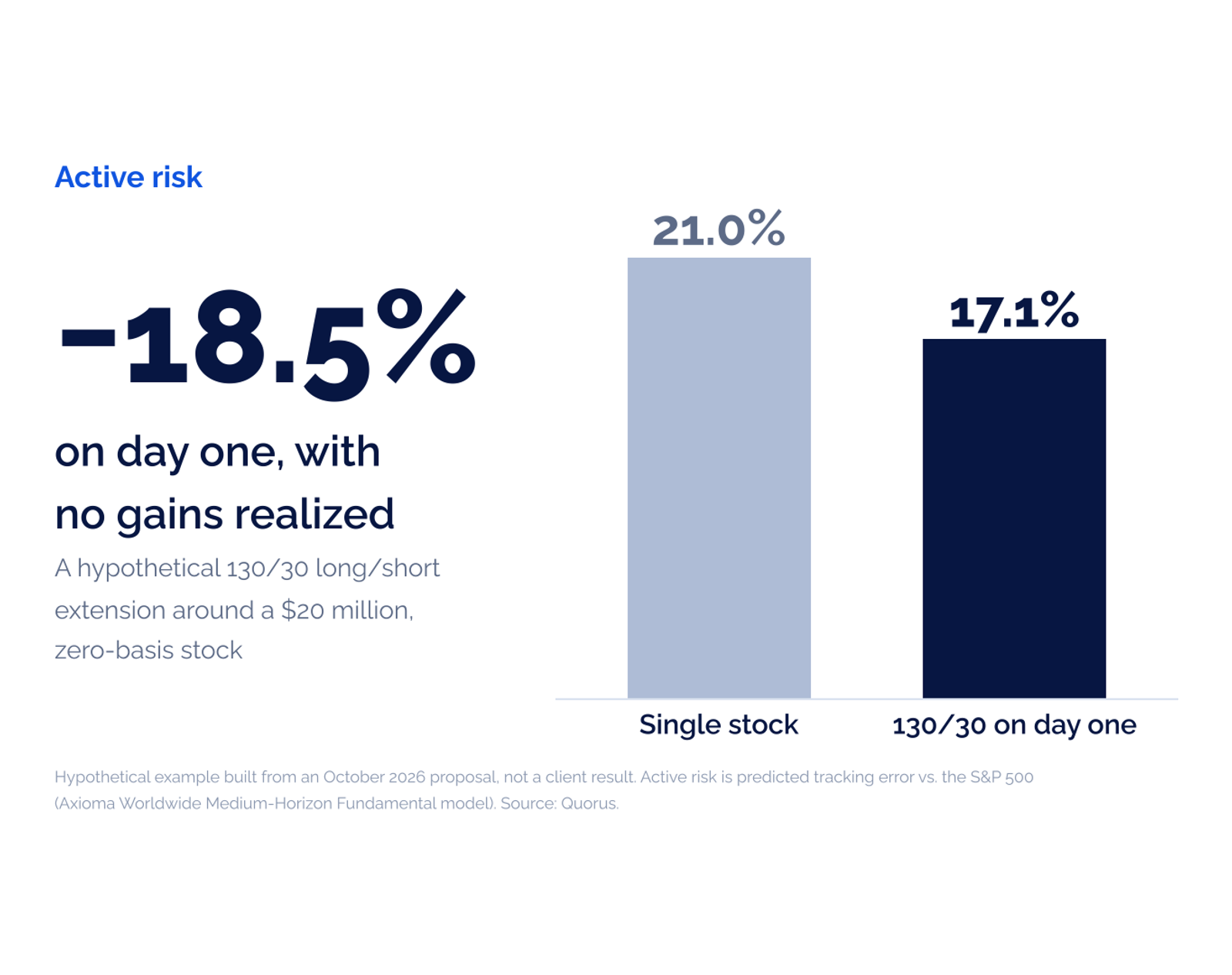
How a 130/30 long/short extension on a zero-basis stock reduces active risk by 18.5% (from 21.0% to 17.1%)
Say you want to diversify a $20 million position in one stock with almost no cost basis, but are understandably wary of the tax bill.
Say you want to diversify a $20 million position in one stock with almost no cost basis, but are understandably wary of the tax bill.
There’s an increasingly popular solution that we recently discussed with our colleagues over at WisdomTree. Using long/short extensions we can diversify, reduce risk, and provide clients a path to reduce their concentrated position while deferring the associated tax bill.
WisdomTree, Inc. is an investor in Quorus, and Quorus serves as a tax-managed SMA provider to WisdomTree. Each therefore has an economic interest in the success of the other. This relationship creates a potential conflict of interest: Quorus may have an incentive to favor WisdomTree and its products.
In the hypothetical example below, we modeled creating a 130/30 portfolio to diversify a $20 million zero-basis stock.
On day one it cut active risk by 18.5% (from 21.0% to 17.1%) without realizing a dollar of gains.
Everything below is a hypothetical analysis built from a proposal, not a client result. The day-one figures come from our proprietary optimization.
Why the extensions do the work
Nothing gets sold on day one. The stock stays in the account. The portfolio adds 30% of new long positions and 30% of short positions, so the account runs 130% long and 30% short against the same net value. No lot is sold, so no gain is realized.
The extensions reshape risk around the position. The longs buy what the stock lacks. The shorts sell what the stock already overweights. The long-short strategy tilts the portfolio, making it look more like the overall market. It is a better starting point.
Realized losses unlock opportunities to sell the concentrated position. Over time, the short book tends to realize losses in rising markets, and losing names on the long side can be harvested too. Each dollar of net realized loss can offset a dollar of gain from selling the stock. With a basis near zero, a dollar of realized loss lets roughly a dollar of stock go out the door with no net gain. And, unlike long-only direct index accounts, the long-short portfolio avoids ossification, allowing the portfolio to continue harvesting losses beyond the first few years. As the portfolio grows, the extensions grow with it, allowing for new cost basis to be added, powering loss-harvesting opportunities.
What we modeled
I built this proposal for an advisor whose client held a single large-cap REIT. The setup:
The starting portfolio
One stock worth $20,001,030, carrying an unrealized long-term gain of $19,930,315. The basis was under 0.4% of market value.
The structure
A 130/30 long-short portfolio. The optimizer added 100 long names and 100 short names. Each short was held at an equal 0.30% weight. The result was 129.90% long, 30.00% short and 0.10% cash.
The day-one objective
Minimize tracking error relative to the S&P500 and add alpha potential through WisdomTree’s multi-factor model. Realized gain on day one was $0. Turnover was 60% of starting portfolio value, all of it new positions, with an estimated transaction cost of $12,002.
The risk model and short screen
Risk statistics come from Axioma's worldwide medium-horizon fundamental model. Before optimizing, the short universe was screened for borrow: names were excluded for high short interest, high days to cover, a low rebate rate, or too little available borrow at the custodian.
What changed on day one
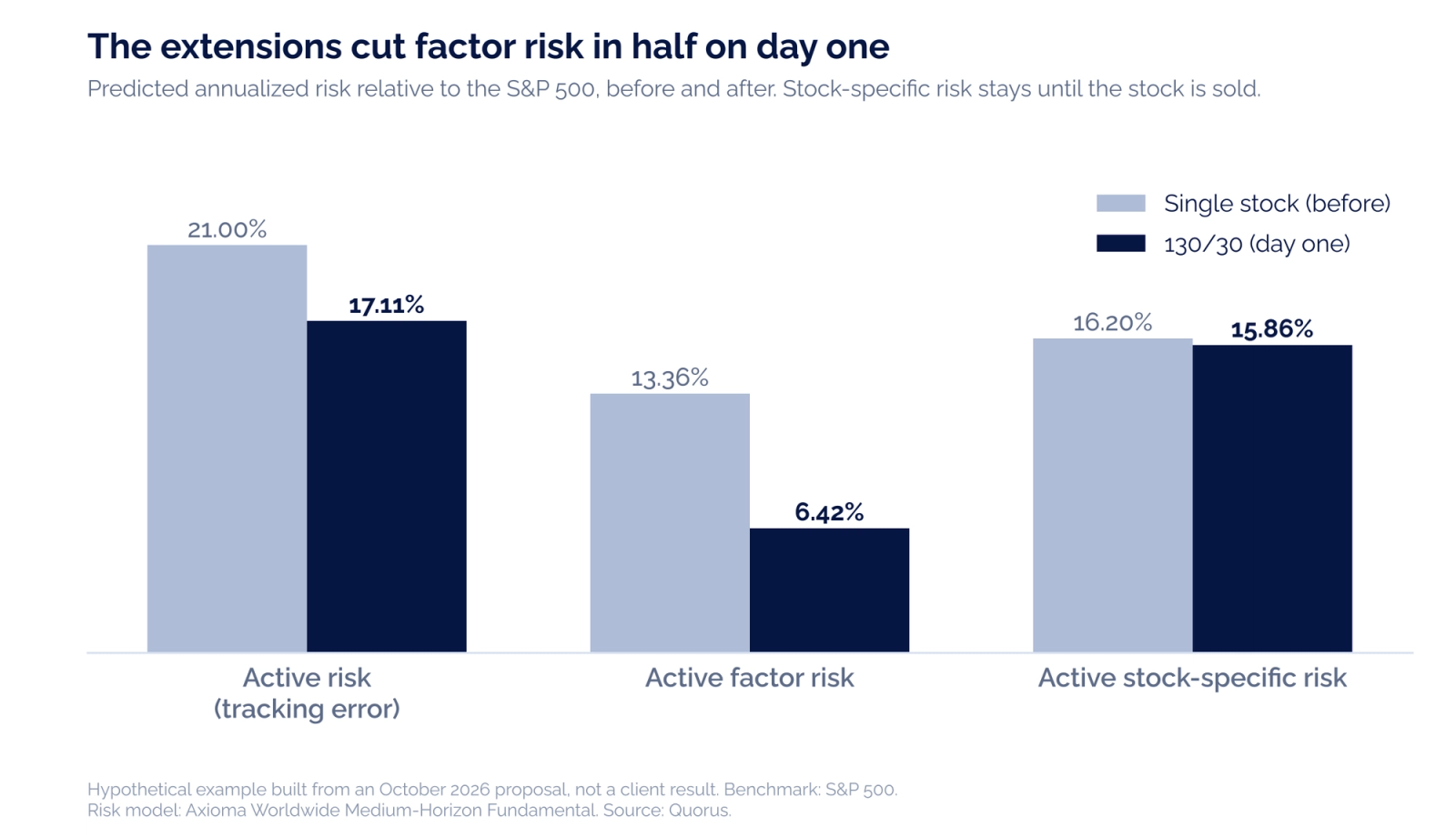
Active risk fell, and factor risk fell by half. Active risk, or expected tracking error, went from 21.00% to 17.11%. Active factor risk went from 13.36% to 6.42%. Most of what made this portfolio different from the market was its factor profile, and that is what the extensions attempt to balance.
Total risk went up. It rose from 19.93% to 21.17%, and predicted beta rose from 0.40 to 0.86. That looks backwards until you look at the stock: a low-beta, high-dividend REIT moves less than the market. Bringing the portfolio closer to the market means taking on more of the market's risk. That is the intended result, not a side effect.
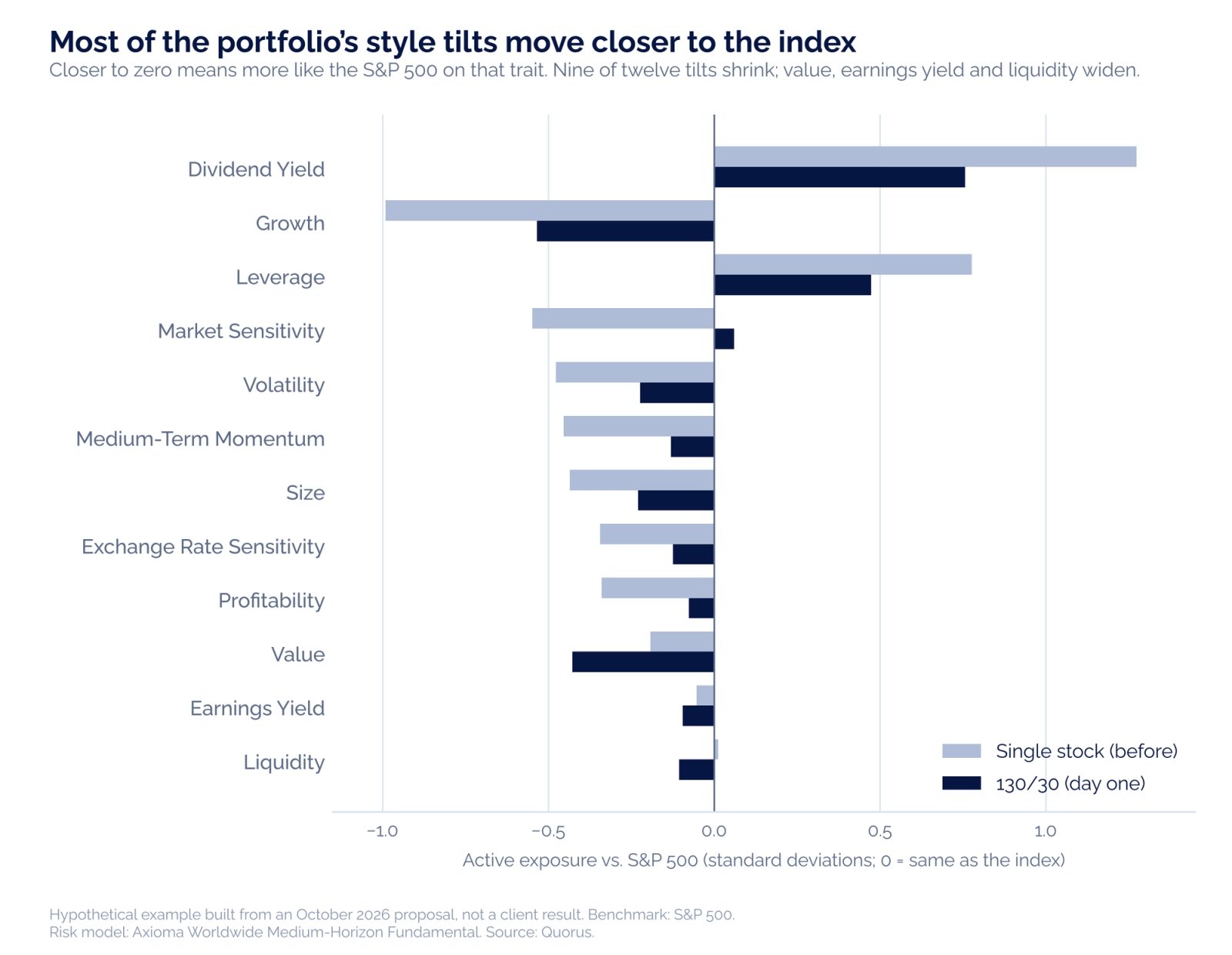
Most tilts narrowed. The portfolio's dividend yield exposure fell by about 41%. Its exposure to market sensitivity went from negative to positive. Net real estate went from 100% to 84.4%, and information technology went from zero to 28.7%.
What the losses could do
As the stock comes down, the optimizer stops minimizing tracking error at any cost. Sector weights normalize, the long book broadens, and the portfolio starts to look like a diversified core with a residual position rather than a single stock with extensions.
What would change the answer
The market path. Short-book losses come mostly in rising markets. A flat or falling market moves the losses to the long side and changes the pace.
Gains elsewhere. If the client realizes gains outside this account, some of these losses go there instead, and less of the stock comes down.
Leverage. A 145/45 would generate more losses than a 130/30. This proposal stayed at 130/30 to limit leverage. Custodian rules also cap the choice: at Schwab today, long/short accounts need $10 million and stop at Reg T margin, which this account clears.
Costs. Borrow, margin interest and higher fees come out of every year.
The alpha model. The extensions need to come from a model expected to add pre-tax return, not from a basket built only to throw off losses. Negative pre-tax alpha can happen, but it should never be the goal. We covered the economic substance question in our SIH Partners piece.
Related shorts. I am neither a lawyer nor an accountant. The short book in this proposal included other REITs, some of them direct competitors of the stock. Positions that offset each other can fall under the straddle rules in Section 1092, which can defer losses. At 0.30% each against a 100% position, these are small, but whether to exclude the closest peers is a design choice to settle with tax counsel before the account funds.
Every concentrated position starts somewhere different
A concentrated position with no basis used to leave three options: hold it, give it away, or pay the tax. A long/short extension adds a fourth that works over years rather than in one trade, and delivers benefits day one.
As always, use an analysis like this as a starting point, not a conclusion. Every client's basis, gains elsewhere, appetite for leverage, and custodian access is different. Think critically about the specifics before deciding whether this structure fits.
As of October 2026.
Report-Specific Disclosures
Tracking error is estimated using the Axioma Worldwide Medium-Horizon Fundamental Model, prices as of October 2026. The target portfolio is a 130/30 long-short portfolio benchmarked to the S&P 500 Index. Current holdings are assumed from the portfolio provided by the advisor to Quorus.
Active risk, factor risk, total risk, beta, and factor and sector exposures are predicted by the same model as of the same date. They are model estimates, not measured results, and they change as markets and holdings change.
Index and exchange-traded fund comparisons are shown for context only. You cannot invest directly in an index. Comparison indexes and funds differ from the strategies described in leverage, holdings, concentration, risk, and cost, and are not intended to represent a substitutable alternative.
The strategies described use leverage and short selling. Leverage magnifies both gains and losses. A short position can lose more than the amount invested and, in theory, without limit. Securities borrowed to establish short positions may become unavailable or more costly, which can force positions to be closed at unfavorable prices. Financing and stock borrow costs reduce returns and are not reflected in the figures shown unless expressly stated. These costs vary with the leverage level, the custodian and the size of the account. They commonly fall between roughly 0.50% and 5.00% of account value a year, and can exceed that at higher leverage levels or in less favorable account circumstances. Quorus cannot predict what any individual account will bear. Higher leverage levels require portfolio margin, and margin requirements may compel liquidation at inopportune times.
Loss harvesting benefits are not assured. Realized losses may be limited, deferred, or disallowed under the wash sale, straddle, and constructive sale rules, among others. Because the strategy holds both long and short positions, it can realize losses in rising as well as falling markets, since short positions lose value when the stocks sold short rise. The amount of losses realized varies with market conditions, the dispersion of returns across stocks, turnover and leverage, and may decline over time as unrealized gains build in the long positions. Tax management defers rather than eliminates gains; liquidating a portfolio realizes the deferred gains and can materially reduce the after-tax outcome relative to continuing to hold.
Any discussion of "tax-alpha," "after-tax gains," or similar terms is for illustrative purposes only. Tax outcomes depend on individual circumstances and may change with future tax-law revisions; results are not guaranteed. Clients remain responsible for all decisions related to their personal tax situation, and Quorus does not provide individualized tax advice.
WisdomTree, Inc. is an investor in Quorus, and Quorus serves as a tax-managed SMA provider to WisdomTree. Each therefore has an economic interest in the success of the other. This relationship creates a potential conflict of interest: Quorus may have an incentive to favor WisdomTree and its products.
Important Disclosures
Quorus Inc. ("Quorus," "we," or "our") is an investment adviser registered with the Securities and Exchange Commission ("SEC"). Registration does not imply a certain level of skill or training.
This material is provided for informational purposes only and does not constitute (i) investment, legal, or tax advice, (ii) an offer to sell or the solicitation of an offer to buy any security, or (iii) a recommendation regarding any investment strategy. Investors should consult their professional advisers before acting on any information herein.
Past performance is not indicative of future results. All investments involve risk, including the possible loss of principal. Certain statements contained herein constitute "forward-looking" or other subjective views and are based on current expectations, estimates, and assumptions that are subject to change without notice. No assurance can be given that any forecast or goal will be achieved.
Services described may be offered through third-party service providers or custodians. Quorus does not custody client assets. References to third-party trademarks and logos are for identification only and do not imply endorsement, sponsorship, or affiliation.
"Quorus" is the trademark of Quorus. All other trademarks are the property of their respective owners.
A copy of Quorus's current Form ADV Parts 2A & 2B, which contain important information about our advisory services, fees, and disciplinary history, is available upon request.
© 2026 Quorus. All rights reserved.