
What tax-aware long-short takeaways we can glean from SIH Partners LLLP v. Commissioner
A Tax Court ruling last week is a useful moment to revisit why economic substance and pre-tax alpha are not optional features of a taxable long/short strategy. They are the foundation.
Before we start, I am neither a lawyer nor an accountant. These takeaways are my own and should not be relied on for legal or tax advice. That said, let’s jump in.
Overview
Last week, the U.S. Tax Court gave our industry another good reminder to slow down and look closely at the foundations of any tax-managed strategy.
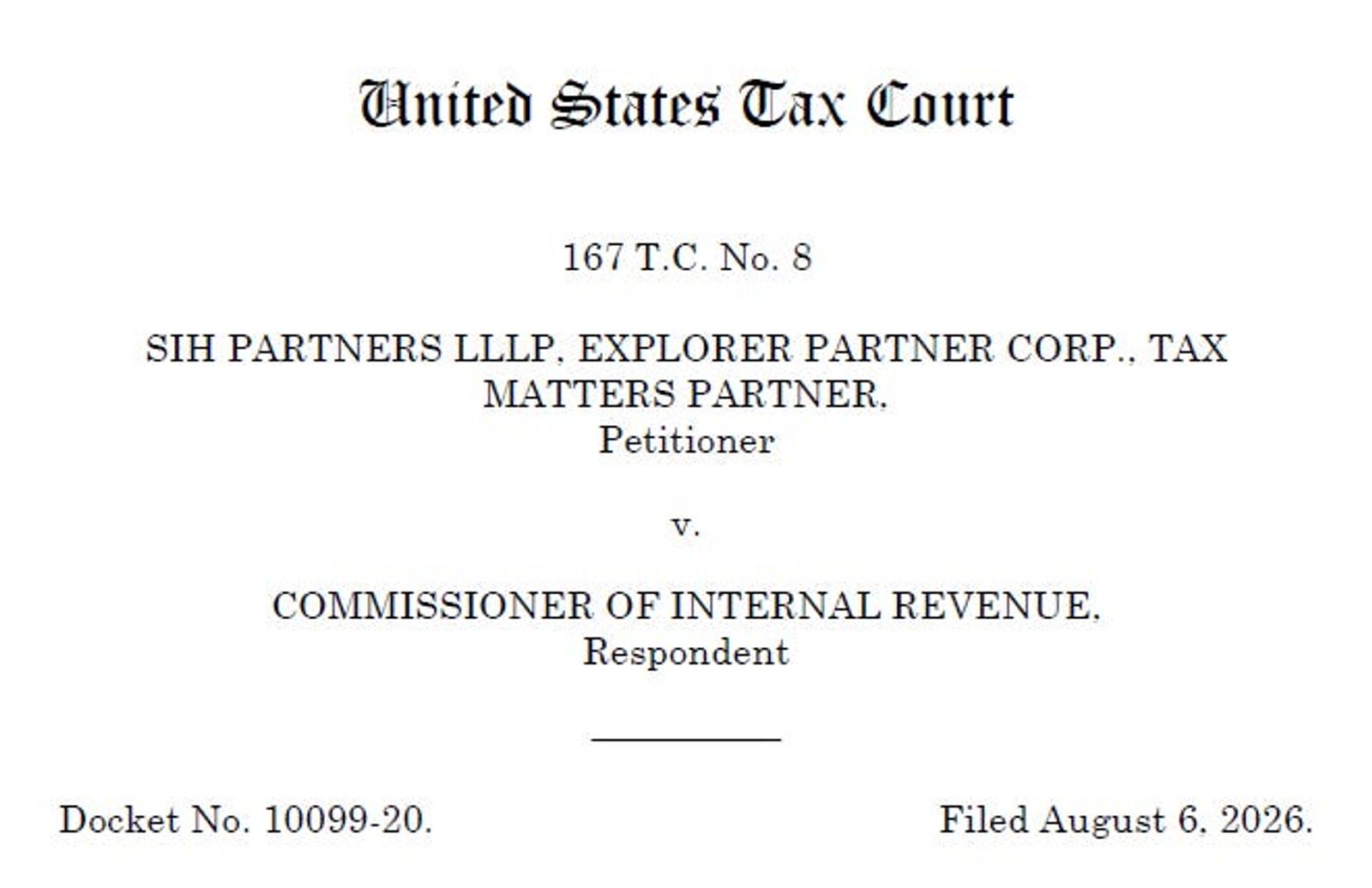
In SIH Partners LLLP v. Commissioner (167 T.C. No. 8, decided August 6, 2026), the court held that, while a hedging strategy employed by Susquehanna International Group (SIG) passed the mechanical Substantial Overlap Test, it failed the Anti-Abuse Rule of Treasury Regulation 1.246-5(c)(1)(vi).
Specifically, the court found that the short leg of the strategy “virtually tracked” the long and that the value of the tax savings generated significantly exceeded the expected pre-tax economic profit of the strategy. As a result, the court reclassified the $170,764,863 of dividends from QDI to ordinary income and disallowed the foreign tax credit claimed by the firm.
This case is not a one-for-one proxy of retail tax-loss harvesting portfolios, but this decision and how it was arrived at provide useful insight into how the economic merits of a strategy involving tax savings are decided. Specifically, it underlines the importance of economic substance in any tax-management strategy, and ensuring that when evaluating investment decisions, firms appropriately ground their analysis in pre-tax investment merits rather than tax avoidance.
The Case
Susquehanna International Group has maintained a “Firm Hedge” since 1987 through various subsidiaries, including SIH Partners LLP. This hedge is designed to cushion the firm against a general market downturn and, by 2012, the hedge consisted of short positions referencing the S&P 500 Index, the Russell 2000 ETF (IWM), and the China Large Cap ETF (FXI).
SIG routinely relocated the hedge among affiliates and changed the form in which it was held, placing it at various times in portfolio swaps, individual swaps, and different prime brokerage accounts, generally to lower financing costs.
In 2010, Morgan Stanley approached SIG with a twofold proposition: move the Firm Hedge to one or more of its foreign entities and enter into a series of agreements structuring a portfolio swap built around four Swiss equities. In exchange, Morgan Stanley would cut its margin requirements by more than half.
Under the new agreement, SIH Partners bought long positions in Nestlé, Novartis, Roche, and Swisscom, held them across their respective ex-dividend dates, and simultaneously entered a portfolio swap giving it identical short positions in the same four names alongside the Firm Hedge shorts, fully offsetting the Swiss equities.
When filing, SIH claimed Qualified Dividend Income status (QDI) on the dividends received from the Swiss equities, lowering the tax rate from the ordinary income rate assessed against ordinary dividends.
What was analyzed
In this case, two primary tests were at play: the Substantial Overlap Test and the Anti-Abuse Rule.
The Substantial Overlap Test, Treasury Regulation § 1.246-5(c)(1)(iii), which states that for dividend treatment, for portfolios to be considered substantially similar, the market value of the portfolio fully offset must be greater than or equal to 70%. In this case, the offsetting positions came to only 64.38% of the portfolio, below the 70% threshold, so the position was not treated as substantially similar. On the mechanics, they complied.
Notwithstanding compliance with the Substantial Overlap Test, however, the Commissioner argued that the transaction failed the Anti-Abuse Rule, Treasury Regulation § 1.246-5(c)(1)(vi), which overrides mechanical compliance. Structurally, the Anti-Abuse Rule has three tests, all of which must be met:
1. Changes in the value of the position are expected to virtually track changes in the value of the target stock.
2. The position is “held as part of a plan a principal purpose of which is to obtain tax savings”.
3. The tax savings are “significantly in excess of the expected pre-tax economic profits” of holding the position.
In this rule, the court found that they did not meet the threshold.
The Opinion
As Judge Weiler wrote in his opinion, “this case turns on the comparison of the expected pretax economic profit to the tax savings. If the latter is “significantly in excess” of the former, then the Anti-Abuse Rule applies, and the relevant holding periods must be reduced.”
To determine this, the court looked at both the outcome of the transaction and the investment analysis conducted by Jeff Cohen, SIG’s equity finance group manager. This analysis originally forecast a pre-tax profit of $2.4M against tax savings the court ultimately put at more than $25M.1
Cohen's expected pre-tax profit vs. tax savings, as adopted by the court (slip op. at 37)
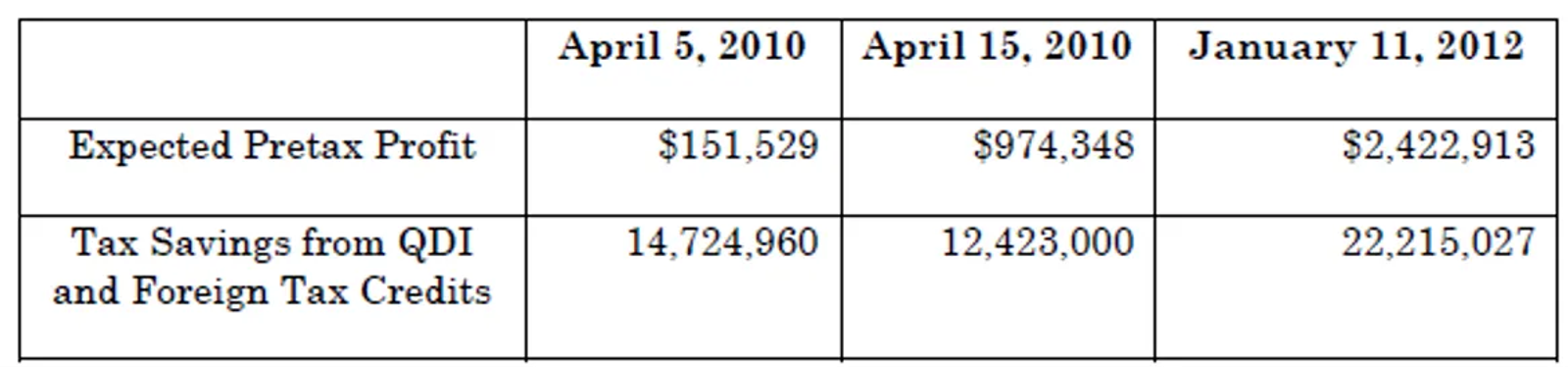
It was also noted that Cohen’s analysis was viewed as somewhat thin, with SIG experts attempting to revise the expected pre-tax profit of the strategy upward and government experts suggesting it could be lower or not profitable at all. In the end, the court continued to rely heavily on Cohen’s original analysis.
Because of this, the court found that this transaction failed the Anti-Abuse Rule, and recharacterized the dividends as ordinary dividends.
Takeaways for practitioners
This is not a 1:1 comparison for tax-aware long-short portfolios, but it rhymes.
The facts of this case have notable differences between the circumstances of SIG’s dividend qualification and the economic substance analysis under Section 7701(o) that is our primary concern with tax-managed long-short portfolios (this case was decided under the Treasury Regulation 1.246 holding-period rules, so the comparison is by analogy rather than a direct application).
That said, how the case was decided is relevant. SIG met the mechanical thresholds to avoid the Substantial Overlap Test, but they still lost the case on the Anti-Abuse Rule because the court found that their approach was primarily designed to obtain tax savings, and the tax savings were significantly in excess of pre-tax profits.
Compare this to U.S. Code § 7701(o)(2)(A), which governs the economic substance of transactions and is primarily what we are concerned with when dealing with long-short tax-managed separate accounts. The code states that:
“The potential for profit of a transaction shall be taken into account in determining whether the requirements… are met with respect to the transaction only if the present value of the reasonably expected pre-tax profit from the transaction is substantial in relation to the present value of the expected net tax benefits that would be allowed if the transaction were respected.”
While the code at issue in SIH Partners is different from the economic substance provision that we are most commonly concerned with tax-managed separate accounts- the two share the same core question, and the case provides useful parallels.2
The Commissioner pushed to apply substance over form, and lost.
Under the substance-over-form doctrine, the Commissioner and the courts may recharacterize a transaction in accordance with its substance if the substance of the transaction is demonstrably contrary to the form.
The Commissioner attempted to use this approach to deconstruct the swap that SIG used into its individual equity exposures, so that the disaggregated Swiss equities would fail the Substantial Overlap Test.
The court rejected this. It found that while SIG had control over the swap and its exposures and modified them from time to time, this did not fall outside the ordinary industry practice.
Judge Weiler quoted: “There has yet to be a case that outright holds tax-avoidance alone may nullify an otherwise Code-compliant and substantive set of transactions… After all, taxpayers may lawfully arrange their affairs to keep taxes as low as possible.”3
This is a reaffirmation that the simple act of tax avoidance is not enough to nullify a transaction if it is conducted in the course of normal practices.
Economic substance remains critically important.
This case provides a useful example of the real-world evaluation of a tax deferral strategy. In this case, although SIG cleared the objective Substantial Overlap Test, the court still found they failed to meet the materiality threshold for the Anti-Abuse Rule, primarily because the tax consequences substantially exceeded the pre-tax benefits.
Further, SIG’s investment analysis about the transaction, and specifically the lack of a significant pre-tax expectation of profit, was a central piece of the decision to find against SIG.
What we believe is important to watch when working with tax-managed strategies.
- Whether the pre-tax economics can stand on their own. If you cannot articulate the pre-tax investment case without reference to the tax outcome, that is a signal worth taking seriously. Teams should have a clear answer to why they reasonably expect the pre-tax profit from the transaction to be substantial in relation to the expected net tax benefits.
- How tax value is described in investment documents. The court paid attention to how the relationship between the long and short positions was characterized in materials that had nothing to do with tax. When presenting this type of strategy to your investment committee, be sure to build a robust foundation in the pre-tax return story in addition to any tax benefits.
- How tax value is described in client materials. The investment committee memo is not the only item that Economic Substance should apply to. Client decks, internal communication, advertisements, conference presentations. All can reinforce or undermine economic substance.
As always, use a decision like this as a starting point, not a conclusion. Every client’s tax situation, capital gains burden, and implementation cost is different, and the same is true of every provider’s approach to constructing the short book. Think critically about the specifics before drawing conclusions.
1 SIH Partners LLLP v. Commissioner, 167 T.C. No. 8, slip op. at 37 (Aug. 6, 2026).
2 It is important to note that Treas. Reg. §1.246-5(c)(1)(vi) is a specific, mechanical anti-abuse override for the §246 holding-period regime. Section 7701(o) is a general tax-benefit disallowance doctrine. Neither test legally subsumes the other, neither result automatically proves the other, and compliance with one does not immunize a transaction from the other.
3 SIH Partners LLLP v. Commissioner, 167 T.C. No. 8, slip op. at 20 (Aug. 6, 2026).
Disclosures
All investing is subject to risk, including possible loss of principal.
Quorus Inc. ("Quorus," "we," or "our") is an investment adviser registered with the Securities and Exchange Commission ("SEC"). Registration does not imply a certain level of skill or training.
The material presented is for informational purposes only and should not be construed as investment advice. It is not a recommendation of, or an offer to sell or solicitation of an offer to buy, any particular security, strategy, or investment product. Investing in securities involves risks, including the potential loss of money, and past performance does not guarantee future results. Historical returns, expected returns, and probability projections are provided for informational and illustrative purposes and may not reflect actual future performance. Nothing in these materials should be construed as personalized investment advice, which can only be provided in one-on-one communications.
Tax-loss harvesting and tax-aware management seek to improve after-tax outcomes but do not guarantee any tax result, and their effect depends on a client's individual circumstances, including tax rates, holding periods, and other activity in the client's accounts. Quorus does not provide tax or legal advice. Clients should consult their own tax and legal advisers.
The views expressed are the personal opinions of John Hill, CFA, Co-Founder and President of Quorus Inc., and should not be regarded as the views of Quorus Inc. or as a description of its advisory services.
Discussion of case law, statutes, regulations, and administrative guidance is general in nature, reflects the author's reading as of the date published, and may be superseded by later developments. It is not legal or tax advice, and no attorney-client or similar relationship is created. Outcomes in reported cases turn on their specific facts and do not predict the treatment of any other arrangement. Readers should consult their own counsel and tax advisers. Hyperlinks to third-party content are provided for convenience and are not an endorsement of that content.
A copy of Quorus's current Form ADV Parts 2A and 2B, which contain important information about our advisory services, fees, and disciplinary history, is available upon request.