
Paper Club #2: Having Your Cake and Eating It Too: The Before and After-Tax Efficiencies of an Extended Equity Mandate
Sixteen years on, this paper is still relevant. There is always value in revisiting foundational work.
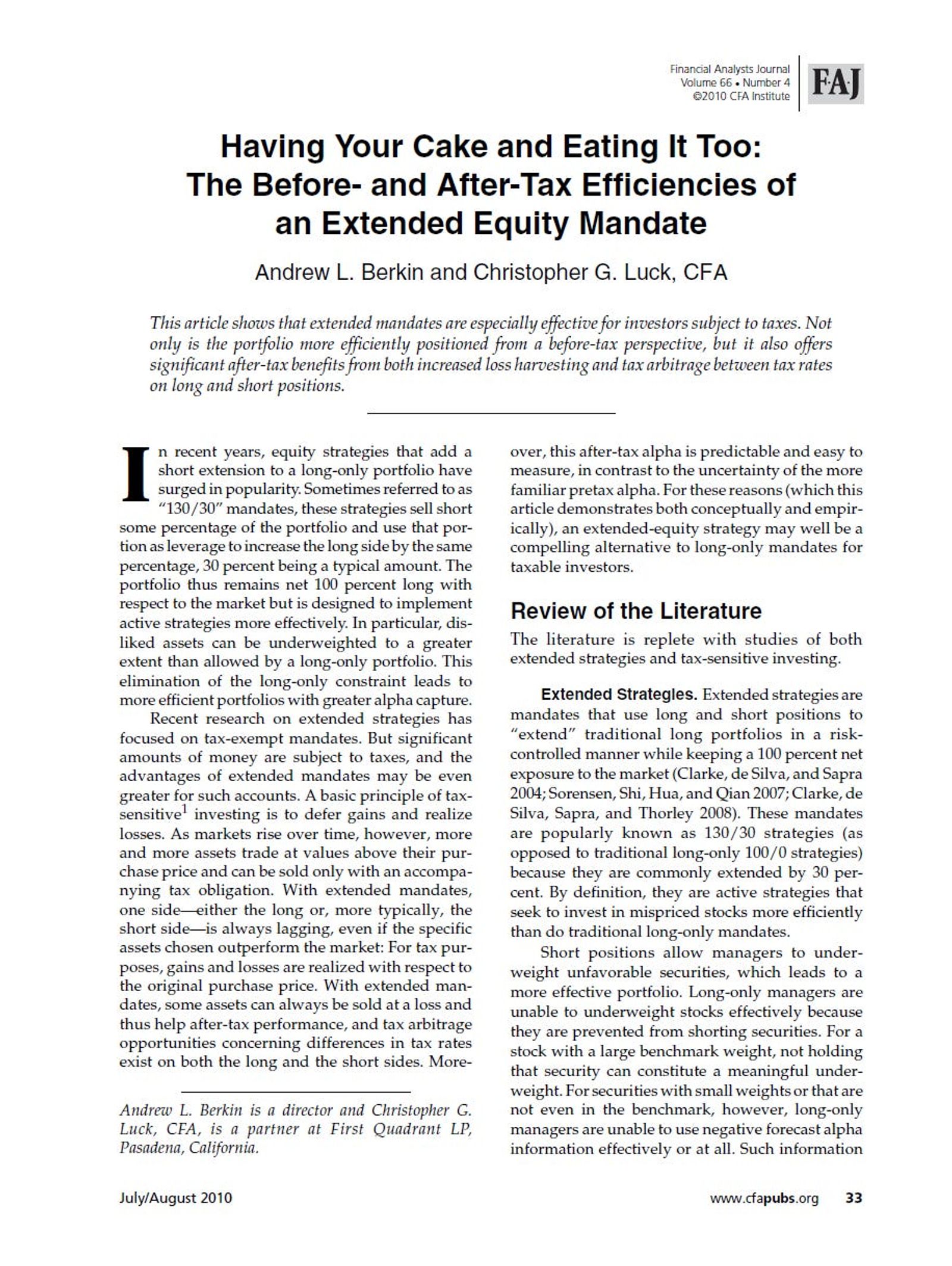
This week, to be joined by Brent Sullivan of Tax Alpha Insider as we go back to basics and dig into one of the most frequently cited papers in long/short research: “Having Your Cake and Eating It Too: The Pre- and After-Tax Efficiencies of an Extended Equity Mandate,” by Andrew Birkin and Christopher Luck.
Published in 2010, this paper has, in many ways, become a structural jumping-off point for the modern approach to tax-managed long/short.
Many of its ideas will now sound familiar: loss generation from a short book, and the role of a short portfolio in better capturing a manager’s alpha.
That said, with all the focus and noise around tax-managed long/short portfolios, we felt it was a good time to re-read what is becoming a classic paper.
TL;DR
- By adding a long/short extension, managers can not only better capture a target alpha signal but also create more opportunities for loss harvesting in both up and down markets.
- The short extension portfolio tends to decline in rising markets, creating a consistent, repeatable source of capital losses regardless of broader market conditions.
- These losses are particularly advantageous because of their short-term character, allowing investors to offset short-term capital gains.
The team’s thoughts
Birkin was ahead of his time.
Birkin first published his working paper in 2009 as primarily an academic exercise. The first AQR paper building on this work didn't come until 2016, and it has only been in the last three years or so that we have seen accelerating flows into this product category.
The major tenets of this paper continue to hold today.
Sixteen years on, this paper’s core arguments remain relevant:
- Short portfolios allow more complete expression of a manager’s alpha signal.
- A short portfolio can generate greater capital losses than a long-only portfolio.
Thank you, Andrew Berkin, for an after-tax liquidation value.
This paper calculates the terminal after-liquidation value of the portfolio. This approach gives a more “true tax value” of a tax-managed portfolio by accounting for the character of the embedded gains the the portfolio.
For example, the non-tax-managed long-only portfolio improves relative to the S&P 500 benchmark after liquidation because its higher turnover caused more gains to be realized during the holding period, leaving it with a higher cost basis and therefore a smaller tax liability at final liquidation than the lower-turnover benchmark.
This has since become a standard in the industry, but Birkin deserves credit for including it and highlighting it more than fifteen years ago.
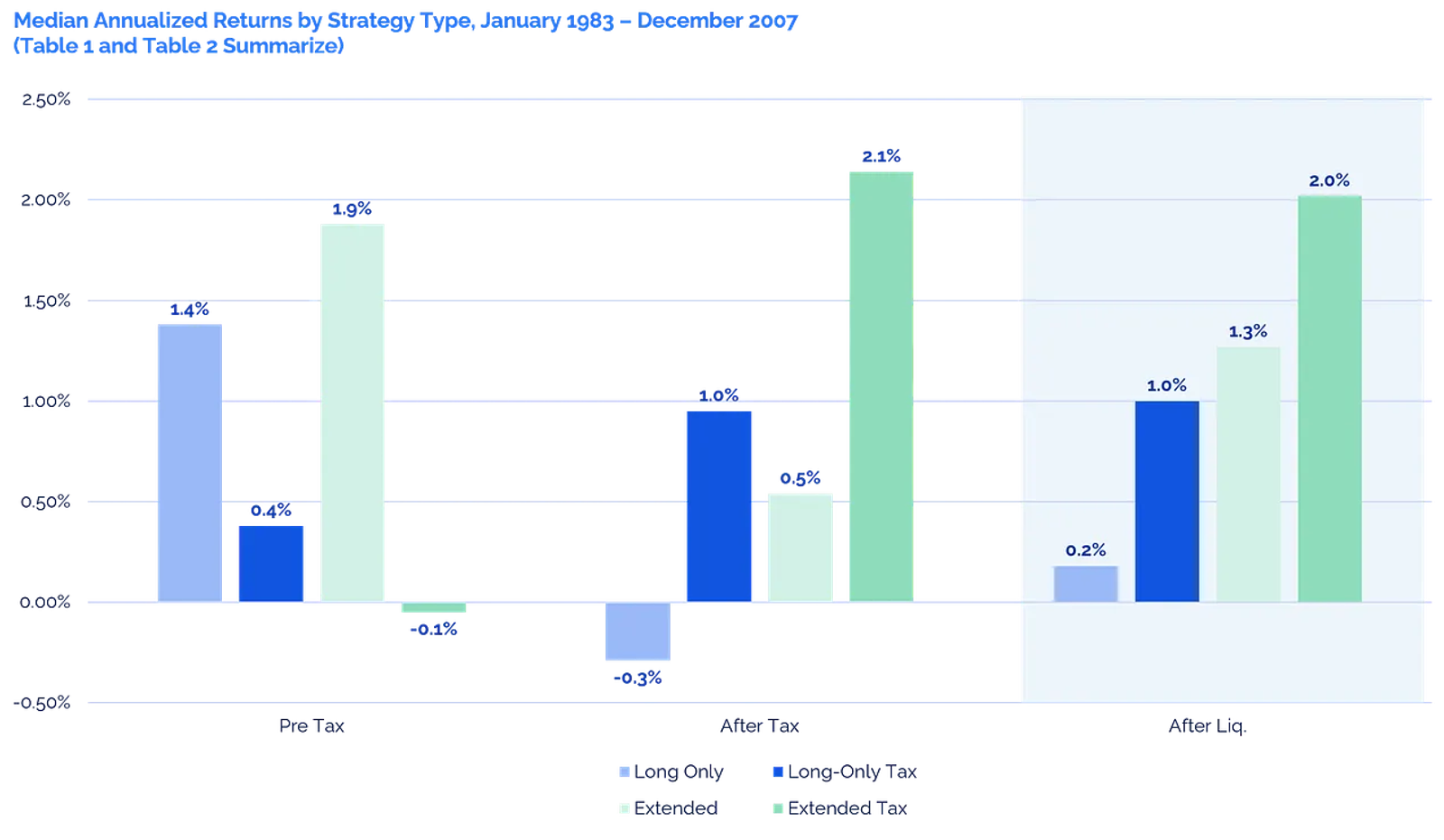
Source: Berkin, Andrew L., and Christopher G. Luck. “Having Your Cake and Eating It Too: The Before- and After-Tax Efficiencies of an Extended Equity Mandate.” Financial Analysts Journal, 66(4), 2010. Data summarized from Tables 1 and 2; values shown are median annualized added returns relative to a passive S&P 500 benchmark for January 1983–December 2007.
Short dividend charges can offset ordinary income.
Brent highlighted this before we started reading, so all credit to him, but the tax treatment of charges on short dividends was new for me. Specifically, if a security is held short for more than 45 days and a dividend charge is incurred, that dividend charge can be used to offset ordinary income. Ordinary income offsets can be harder to generate, so it’s a nice, albeit smaller benefit for investors.
The magic source of capital gains.
Like many papers in this space, Birkin and Luck assume that any losses generated within the portfolio are offset by gains of equal character and reinvested as cash flow. Because long/short portfolios generate substantial short-term capital losses, this assumption can reward loss harvesting generously.
As a summary of Table 2 shows, both the long-only tax-managed portfolio and extended (long/short) tax-managed portfolio benefit from short-term loss realization, but the magnitude of the tax benefit for the long/short portfolio is substantial.
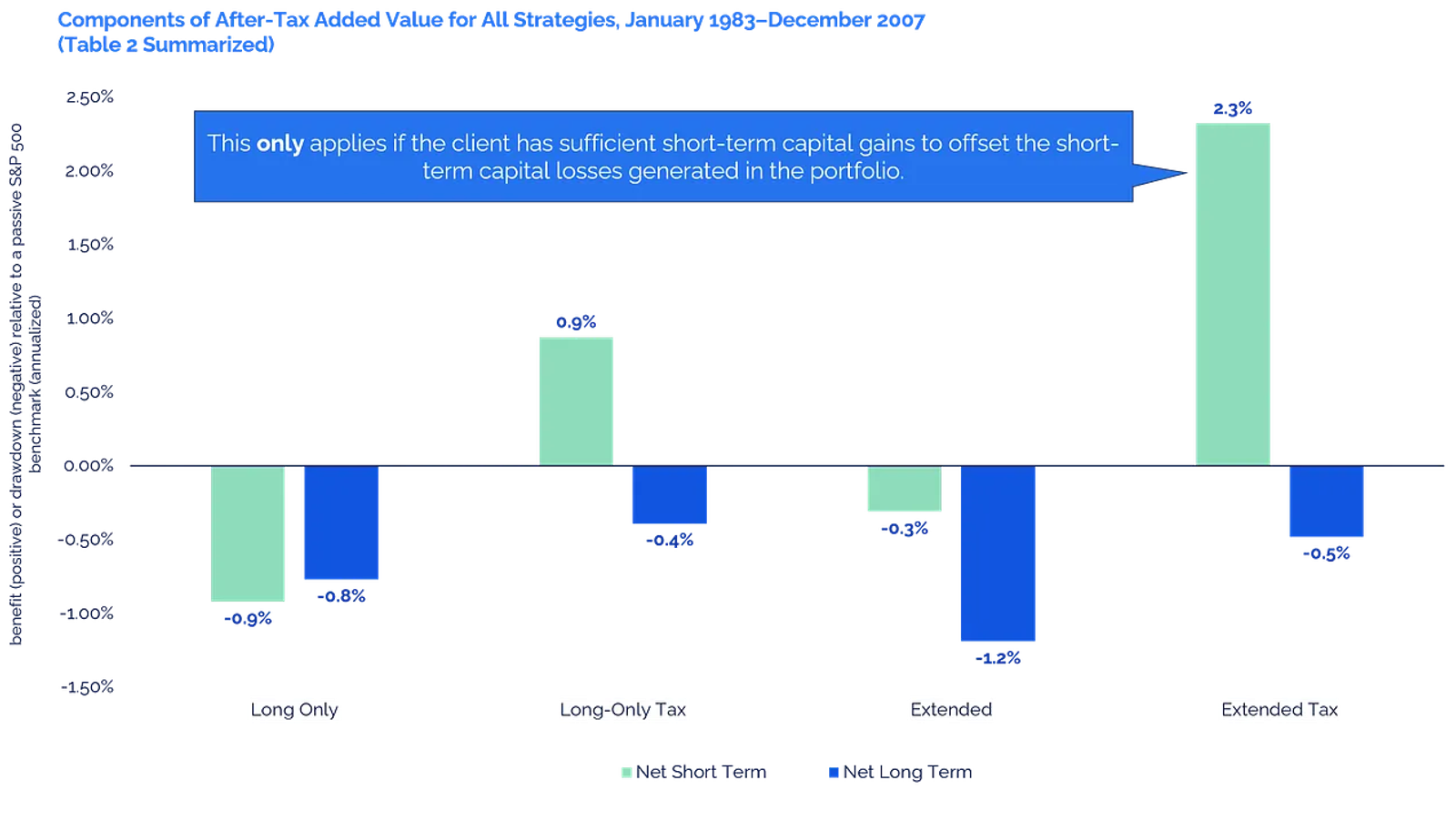
Source: Berkin, Andrew L., and Christopher G. Luck. “Having Your Cake and Eating It Too: The Before- and After-Tax Efficiencies of an Extended Equity Mandate.” Financial Analysts Journal, 66(4), 2010. Data summarized from Tables 1 and 2; values shown are median annualized added returns relative to a passive S&P 500 benchmark for January 1983–December 2007.
Taxes are great, but economic substance matters.
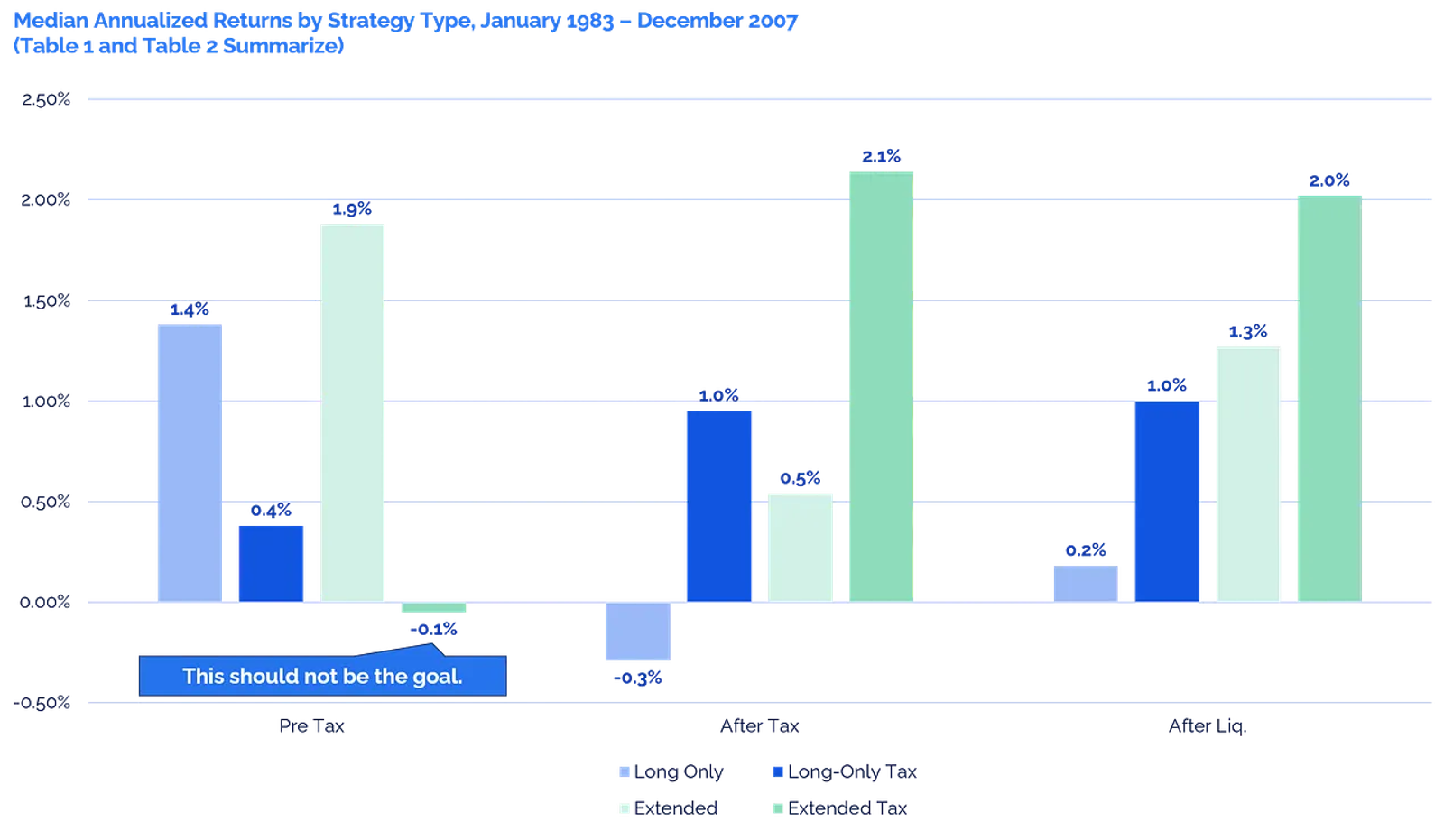
Negative pre-tax alpha can happen, but it should never be the goal.
The paper notes that for the median tax-sensitive extended mandate, pretax added value was slightly negative. The authors are clear that this resulted in part from the hindrance of taxes in setting optimal positions, and from trades made for their known tax benefit, not from a strategy designed to lose money before taxes.
This distinction is critical for economic substance determinations, and practitioners should keep it front of mind when evaluating or implementing tax-managed long/short strategies.
Source: Berkin, Andrew L., and Christopher G. Luck. “Having Your Cake and Eating It Too: The Before- and After-Tax Efficiencies of an Extended Equity Mandate.” Financial Analysts Journal, 66(4), 2010. Data summarized from Tables 1 and 2; values shown are median annualized added returns relative to a passive S&P 500 benchmark for January 1983–December 2007.
Closing thoughts
This paper laid the groundwork for understanding the tax benefits of a long/short portfolio and has enabled the industry to continue refining how and where tax-managed long/short strategies can drive alpha for clients.
While this and many of the papers that have followed demonstrate compelling value from loss generation, not every client stands to benefit equally from the losses generated. Even clients who are well-suited for this type of product may not capture the full benefit that is quoted in these analyses.
Use these papers and analyses as a starting point in your assessment of client fit, but think critically about your client’s specific tax situation, their capital gains burden, and the true cost of implementing a long/short portfolio before drawing conclusions about whether it is the right solution for them.
Disclosures
All investing is subject to risk, including possible loss of principal.
Quorus Inc. ("Quorus," "we," or "our") is an investment adviser registered with the Securities and Exchange Commission ("SEC"). Registration does not imply a certain level of skill or training.
The material presented is for informational purposes only and should not be construed as investment advice. It is not a recommendation of, or an offer to sell or solicitation of an offer to buy, any particular security, strategy, or investment product. Investing in securities involves risks, including the potential loss of money, and past performance does not guarantee future results. Historical returns, expected returns, and probability projections are provided for informational and illustrative purposes and may not reflect actual future performance. Nothing in these materials should be construed as personalized investment advice, which can only be provided in one-on-one communications.
Tax-loss harvesting and tax-aware management seek to improve after-tax outcomes but do not guarantee any tax result, and their effect depends on a client's individual circumstances, including tax rates, holding periods, and other activity in the client's accounts. Quorus does not provide tax or legal advice. Clients should consult their own tax and legal advisers.
The views expressed are the personal opinions of John Hill, CFA, Co-Founder and President of Quorus Inc., and should not be regarded as the views of Quorus Inc. or as a description of its advisory services.
Discussion of third-party research reflects the authors' reading of that research and is provided for educational purposes. Certain information contained herein has been obtained from third-party sources. While taken from sources believed to be reliable, Quorus has not independently verified such information and makes no representations about its accuracy or its appropriateness for a given situation. Hyperlinks to third-party content are provided for convenience and are not an endorsement of that content.
A copy of Quorus's current Form ADV Parts 2A and 2B, which contain important information about our advisory services, fees, and disciplinary history, is available upon request.